

Tag: outsourced DPO

Data protection has become a cornerstone of modern business operations. With increasing cyber threats and stringent regulatory requirements, companies across the UK face mounting pressure to safeguard customer information whilst maintaining operational efficiency. The market of data security continues to evolve rapidly, making professional data protection services more crucial than ever before.
Understanding Data Protection Requirements
The General Data Protection Regulation fundamentally changed how organisations handle personal information. Since its implementation in 2018, businesses have grappled with complex requirements that extend far beyond simple password policies. Data protection encompasses everything from secure storage systems to comprehensive breach response protocols.
Many organisations underestimate the breadth of data protection responsibilities. It involves not just technical measures but also organisational policies, staff training, and continuous monitoring. The Information Commissioner’s Office regularly updates guidance, adding another layer of complexity for businesses trying to stay compliant whilst focusing on their core operations.
Small and medium enterprises often struggle most with these requirements. Unlike large corporations with dedicated compliance teams, smaller businesses must balance data protection obligations with limited resources. This challenge has driven demand for professional data protection services that provide expertise without the overhead of full-time specialists.
The True Cost of Data Breaches
Recent statistics paint a sobering picture of data breach consequences. The average cost of a data breach in the UK now exceeds £3 million, but financial losses represent just one aspect of the damage. Reputational harm often proves more devastating, with customer trust taking years to rebuild after a significant incident.
Consider the case of a Manchester-based retailer that suffered a breach affecting 50,000 customers. Beyond the immediate ICO fine of £400,000, they lost 30% of their customer base within six months. The incident highlighted how quickly data protection failures can unravel years of business growth.
Insurance premiums also spike following breaches. Many businesses discover their cyber insurance provides limited coverage, especially when basic security measures were absent. Professional data protection support helps organisations implement strong measures that reduce both breach likelihood and insurance costs.
Core Components of Effective Data Protection
Successful data protection strategies rest on several fundamental pillars. First, organisations must understand what personal data they hold and where it resides. This data mapping exercise often reveals surprising information flows that create unnecessary risks.
Access controls form another critical component. Too many businesses still operate with outdated permission structures where employees access information beyond their requirements. Modern data protection services implement principle of least privilege approaches, ensuring staff only access data necessary for their roles.
Encryption represents a technical safeguard that many organisations overlook. Whilst it sounds complex, proper encryption implementation provides powerful protection against unauthorised access. Professional services ensure encryption covers data both at rest and in transit, closing common vulnerability gaps.
Regular security assessments identify weaknesses before malicious actors exploit them. These assessments go beyond basic vulnerability scans, examining organisational processes and human factors that often create the greatest risks.
Benefits of Professional Data Protection Services
Engaging professional data protection services delivers multiple advantages beyond mere compliance. Expertise remains the primary benefit – specialists bring deep knowledge of evolving threats and regulatory requirements that internal teams rarely match.
Cost efficiency often surprises businesses exploring these services. Whilst the initial investment might seem significant, it pales compared to breach costs or maintaining equivalent in-house expertise. Professional services scale with business needs, avoiding the fixed costs of permanent staff.
Peace of mind proves invaluable for business leaders. Knowing that data protection experts monitor and maintain security measures allows management to focus on growth and innovation. This confidence extends to customers who increasingly choose businesses demonstrating strong data protection commitments.
Continuous improvement characterises professional services. Rather than implementing static measures, experts adapt strategies as threats evolve and regulations change. This dynamic approach ensures businesses remain protected against emerging risks.
Choosing the Right Data Protection Partner
Selecting appropriate data protection services requires careful consideration. Experience within your industry sector matters significantly – healthcare data protection differs markedly from retail requirements. Look for providers demonstrating specific expertise relevant to your operations.
Transparency in service delivery indicates professionalism. Quality providers clearly explain their methodologies, provide regular updates, and maintain open communication channels. Beware of services promising instant compliance or guaranteed breach prevention – honest providers acknowledge that data protection requires ongoing effort.
Scalability ensures services grow with your business. Start-ups need different support than established enterprises, but your provider should accommodate growth without requiring complete service overhauls. Flexible service models adapt to changing business needs.
References and case studies provide valuable insights. Reputable GDPR compliance providers willingly share success stories and connect prospective clients with existing customers. These conversations reveal real-world service quality beyond marketing materials.
Implementation and Ongoing Management
Successful data protection service implementation follows structured approaches. Initial assessments establish baseline security postures and identify immediate priorities. This phase often uncovers quick wins – simple changes delivering significant security improvements.
Policy development creates frameworks for ongoing protection. Generic templates rarely suffice; effective policies reflect specific business operations and risk profiles. Professional services craft bespoke policies that staff understand and follow.
Training programmes embed data protection within organisational culture. Technical measures fail without human compliance. Regular training sessions, tailored to different roles, ensure all staff understand their data protection responsibilities.
Incident response planning prepares organisations for potential breaches. Having clear procedures reduces response times and minimises damage when incidents occur. Professional services provide 24/7 support, ensuring expert assistance when most needed.
Future-Proofing Your Data Protection Strategy
Data protection requirements will undoubtedly increase as technology advances and privacy concerns grow. Artificial intelligence and machine learning create new data processing challenges requiring evolved protection strategies. Professional services help organisations prepare for these emerging requirements.
Regulatory markets continue shifting globally. Whilst GDPR provides current frameworks, new regulations emerge regularly. International data transfers face particular scrutiny, requiring sophisticated approaches to maintain compliance across jurisdictions.
Technology evolution demands adaptive strategies. Cloud services, Internet of Things devices, and remote working create new vulnerabilities. Professional data protection services anticipate these challenges, implementing measures that provide strong protection whilst enabling business innovation.
Conclusion
Data protection services represent essential investments for modern businesses. The combination of regulatory requirements, cyber threats, and customer expectations makes professional support increasingly valuable. Organisations attempting to manage data protection internally often discover the complexity exceeds their capabilities, leading to dangerous gaps in protection.
Athlex Ltd provides comprehensive data protection services tailored to UK businesses. With deep expertise in GDPR compliance and practical experience across various sectors, their outsourced DPO services deliver the protection modern businesses require. By partnering with data protection specialists, organisations can focus on growth whilst ensuring customer data remains secure and regulatory requirements are met.

The decision to appoint a data protection officer often feels daunting for UK businesses. While some organisations legally require a DPO under GDPR, many others recognise the value of professional data protection oversight even when not mandated. An outsourced DPO offers a compelling solution, providing expert guidance without the overhead of a full-time employee. This approach delivers significant benefits that extend far beyond basic compliance.
Understanding the DPO Requirement
GDPR Article 37 outlines specific circumstances requiring DPO appointment. Public authorities must have one, as must organisations whose core activities involve regular and systematic monitoring of individuals on a large scale. Companies processing special category data as a core activity also fall under this requirement. However, determining whether your organisation meets these criteria isn’t always straightforward.
The complexity begins with defining “core activities” and “large scale.” Regulators provide guidance, but grey areas remain. Many organisations operate near the threshold, unsure whether they legally require a DPO. Others clearly fall outside mandatory requirements but recognise the value of professional data protection oversight.
Even when not legally required, appointing a DPO demonstrates commitment to data protection. It sends a powerful message to customers, partners, and regulators about taking privacy seriously. In an era of increasing data breaches and privacy concerns, this commitment provides competitive advantages.
The reality is that all organisations processing personal data need someone responsible for data protection. Whether titled DPO or privacy lead, someone must ensure GDPR compliance, respond to data subject requests, and manage privacy risks. The question becomes how best to fulfil this need.
Why Outsourcing Makes Sense
Outsourcing DPO services uk businesses need provides numerous advantages over hiring internally. The most obvious benefit is cost. A qualified in-house DPO commands substantial salary, benefits, and ongoing training investment. Senior professionals with appropriate experience often expect compensation exceeding £70,000 annually in major UK cities.
Beyond direct employment costs, consider the hidden expenses. Recruitment takes time and money, with no guarantee of finding suitable candidates quickly. Once hired, new DPOs need time to understand your business, build relationships, and establish credibility. If they leave, the process starts again.
An outsourced data protection officer brings immediate expertise without these overheads. They’ve worked with multiple organisations, understanding common challenges and proven solutions. This breadth of experience proves invaluable when addressing complex compliance issues or implementing best practices.
Independence represents another crucial advantage. Internal employees face inherent conflicts of interest. They rely on the organisation for their livelihood, potentially compromising their ability to challenge senior management or recommend costly but necessary changes. An external GDPR consultant maintains professional independence, providing objective advice even when it’s uncomfortable.
Scalability offers practical benefits for growing businesses. Data protection needs fluctuate with business activities. Launching new products, entering new markets, or implementing new technologies create temporary spikes in privacy work. An outsourced provider scales support accordingly, increasing assistance during busy periods and reducing it when needs diminish.
Key Responsibilities of Your Outsourced DPO
Understanding what an outsourced DPO does helps organisations maximise value from the relationship. While specific activities vary by organisation, certain core responsibilities remain consistent across engagements.
Regulatory liaison tops the list. Your DPO serves as the primary contact point with the Information Commissioner’s Office and other supervisory authorities. They handle correspondence, manage investigations, and ensure appropriate responses to regulatory inquiries. This expertise proves invaluable during stressful situations like data breach notifications or compliance audits.
Risk assessment and mitigation form another crucial function. Your DPO identifies privacy risks across business operations, prioritising them based on likelihood and impact. They develop practical mitigation strategies balancing protection with business needs. This might involve recommending technical controls, updating policies, or redesigning processes.
Training and awareness activities ensure staff understand their data protection obligations. Your DPO develops training programmes tailored to different roles, from general awareness for all employees to specific guidance for high-risk functions. Regular updates keep pace with regulatory changes and emerging threats.
Policy development and maintenance keeps documentation current and comprehensive. Your DPO reviews existing policies, identifies gaps, and drafts new procedures as needed. They ensure policies reflect actual practices while meeting regulatory requirements. This documentation proves essential during audits or investigations.
Data subject request management requires careful handling. Your DPO establishes processes for receiving, validating, and responding to access requests, deletion requests, and other individual rights. They balance legal obligations with practical constraints, ensuring timely compliant responses.
Building Effective Relationships
Success with an outsourced DPO depends on building strong working relationships. This starts with clear expectations on both sides. Define roles, responsibilities, and communication channels from the outset. Establish regular reporting requirements and escalation procedures for urgent matters.
Integration with existing teams proves crucial. Your DPO needs to understand business operations, culture, and constraints. Introduce them to key stakeholders early, ensuring they build relationships across the organisation. The most effective DPOs become trusted advisors rather than external consultants.
Communication styles matter. Some organisations prefer formal monthly reports and quarterly board presentations. Others favour informal weekly catch-ups and ad-hoc advice. Discuss preferences openly, adjusting approaches as relationships develop. The goal is finding communication methods that keep everyone informed without creating unnecessary bureaucracy.
Knowledge transfer should flow both directions. Your DPO brings privacy expertise, while your team understands business operations. Encourage open dialogue where both parties share insights. The best outcomes emerge when privacy compliance and business objectives align.
Measuring Success
Defining success metrics helps ensure outsourced data protection delivers value. While compliance remains the primary goal, effective programmes deliver broader benefits worth tracking.
Compliance indicators provide obvious starting points. Track completion of required activities like privacy impact assessments, policy updates, and training sessions. Monitor response times for data subject requests and regulatory correspondence. Measure reduction in compliance gaps identified through audits or assessments.
Risk reduction metrics demonstrate programme effectiveness. Track identified risks, implemented controls, and residual risk levels. Monitor security incidents, near misses, and actual breaches. Declining incident rates suggest improving data protection practices.
Business benefits often surprise organisations. Many find that structured data protection programmes improve operational efficiency. Clear data inventories enable better decision-making. Defined retention schedules reduce storage costs. Privacy-conscious design creates better customer experiences.
Staff engagement provides another success indicator. Track training completion rates, policy acknowledgements, and questions raised. Increasing engagement suggests growing privacy awareness and culture change. The most successful programmes see staff proactively identifying privacy issues rather than waiting for DPO intervention.
Common Challenges and Solutions
Every organisation faces data protection challenges. Understanding common issues helps set realistic expectations and develop effective solutions. Your outsourced DPO has likely encountered similar situations before, accelerating problem resolution.
Resource constraints affect most organisations. Data protection competes with other priorities for limited budgets and attention. Effective DPOs understand these constraints, recommending phased approaches that address highest risks first. They help build business cases for necessary investments, demonstrating return through risk reduction and efficiency gains.
Legacy systems create ongoing headaches. Older technologies often lack modern security features or audit capabilities. Wholesale replacement rarely proves feasible. Your DPO helps develop compensating controls, policy workarounds, and migration strategies that manage risks while respecting practical constraints.
Cultural resistance emerges in many organisations. Staff may view data protection as bureaucratic overhead hindering their work. Skilled DPOs address resistance through education, demonstrating how good data protection practices actually simplify work and reduce risks. They find champions within teams who influence colleagues positively.
Regulatory uncertainty challenges even experienced professionals. Data protection law continues evolving through new legislation, regulatory guidance, and court decisions. Your DPO monitors developments, assessing impacts on your organisation and recommending appropriate responses.
Selecting Your Outsourced DPO Provider
Choosing the right provider requires careful evaluation. Start by confirming appropriate qualifications and experience. Look for recognised privacy certifications, relevant degree qualifications, and demonstrable experience in your sector.
Industry knowledge matters. Healthcare organisations face different challenges than financial services or retail businesses. Providers familiar with your sector understand specific requirements, common challenges, and practical solutions. They speak your language and grasp operational constraints.
Service scope deserves attention. Some providers offer basic compliance checking while others provide comprehensive support including training, audit preparation, and incident response. Consider current and future needs when evaluating options. Starting relationships with providers offering broader services provides flexibility as needs evolve.
Cultural fit influences success. Meet potential DPOs before committing. Assess whether their communication style, approach, and values align with your organisation. The most qualified provider delivers little value if personality clashes prevent effective collaboration.
Reference checking provides valuable insights. Speak with current clients facing similar challenges. Ask about responsiveness, practical value, and working relationships. The best providers readily share references, confident in their service delivery.
Making the Transition
Transitioning to an outsourced DPO requires planning for smooth implementation. Start by documenting current data protection arrangements, identifying what works well and what needs improvement. This baseline helps your new DPO understand starting positions and priorities.
Knowledge transfer from any existing privacy resources proves crucial. Whether replacing an internal DPO or formalising ad-hoc arrangements, capture institutional knowledge before it disappears. Document key relationships, ongoing projects, and known issues requiring attention.
Stakeholder communication manages expectations across the organisation. Explain why you’re appointing an outsourced DPO, what they’ll do, and how people should interact with them. Address concerns about external oversight early, emphasising benefits rather than allowing suspicion to build.
Quick wins build credibility and momentum. Work with your DPO to identify improvements deliverable within the first few months. These might include updating critical policies, resolving overdue data subject requests, or delivering targeted training. Early successes demonstrate value and encourage ongoing support.
The Long-term Perspective
Viewing outsourced DPO services as long-term partnerships rather than short-term fixes delivers greatest value. Privacy compliance isn’t a project with defined endpoints – it’s an ongoing journey requiring continuous attention.
Regulatory landscapes will continue evolving. New technologies create novel privacy challenges. Customer expectations keep rising. Your outsourced DPO helps navigate these changes, ensuring your organisation adapts appropriately. Their broad experience across multiple clients provides early warning of emerging trends.
Building internal capability should remain a goal even with outsourced support. The most effective DPO relationships develop client skills over time. Through training, mentoring, and knowledge transfer, organisations become increasingly self-sufficient for routine matters while retaining expert support for complex issues.
Regular relationship reviews ensure ongoing alignment. Annual assessments of service delivery, changing needs, and relationship health keep partnerships productive. Don’t hesitate to discuss concerns or request changes – good providers welcome feedback and adapt accordingly.
Conclusion
An outsourced DPO transforms data protection from a compliance burden into a business enabler. By providing expert guidance, independence, and scalability, they help organisations navigate complex requirements while controlling costs. The key lies in selecting the right partner and building effective working relationships.
Athlex Ltd offers comprehensive outsourced DPO services designed for UK businesses. Our experienced team provides the perfect blend of legal expertise and business pragmatism. We understand that effective data protection must work within real-world constraints while ensuring robust compliance.
Whether you need full DPO services or targeted support for specific challenges, our privacy experts deliver tailored solutions that protect your business and build customer trust. Transform your approach to data protection today – contact Athlex Ltd to discover how outsourced DPO services can benefit your organisation.
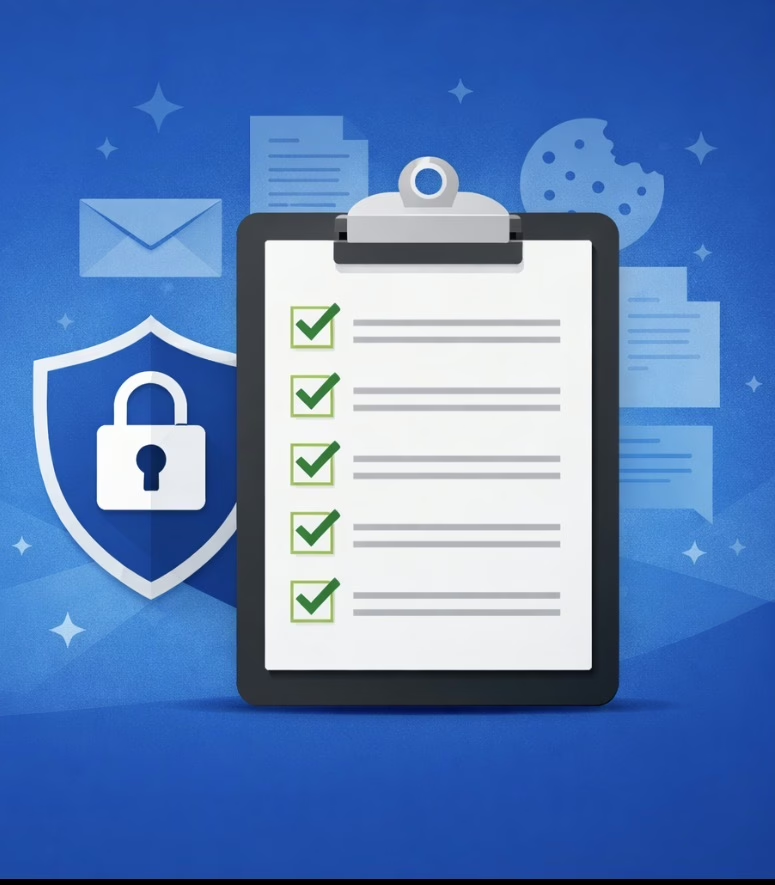
Running a business in the UK already comes with enough admin to make you question your life choices. Data protection should not be the thing that tips you over the edge.
If you collect personal data (and you probably do, even if it is “just” website enquiries, staff records, or customer emails), you need the basics in place. The good news: UK GDPR compliance is very doable when you focus on what actually matters.
This guide gives you a clear, practical checklist you can work through. No jargon. No panic. Just the steps that reduce risk and build trust.
If you want someone to sanity check it all, Athlex can help too, either one off or as your outsourced DPO. (More on that later.)
What counts as “personal data” in practice?
Personal data is information that can identify someone, directly or indirectly. Think:
- Names, emails, phone numbers
- Customer account details
- IP addresses and online identifiers
- Staff HR files and payroll details
- CCTV footage (yes, still personal data)
If your business collects any of that, UK GDPR applies.
The Athlex UK GDPR checklist
1) Write a privacy notice that matches reality
our privacy notice is how you meet the transparency requirement: telling people what you do with their data, in a way they can understand. The ICO expects privacy information to include the required points under the transparency obligations (including Articles 13 and 14). (ICO)
Quick win: check your privacy notice answers these questions:
- What data do you collect?
- Why are you collecting it (your purposes)?
- What lawful basis are you relying on?
- Who do you share it with (like processors and platforms)?
- How long do you keep it?
- What rights do people have and how do they use them?
- How can they contact you (and the ICO)?
If your notice is a copy paste from 2019, it is not “fine”. It is a trust leak.
Internal link suggestion: Review your website privacy notice as part of your toolkit offering (example link): [Website privacy notice review](/templates).
2) Sort your cookies and tracking (because the internet is nosey)
If your website uses analytics, marketing tags, pixels, embedded content, or anything that stores or accesses info on a user’s device, you need to follow the PECR rules on “storage and access technologies”. The ICO’s guidance explicitly covers cookies, tracking pixels, fingerprinting techniques, scripts and tags, and explains that PECR allows this only in certain circumstances or with valid consent. (ICO)
Also worth knowing: the ICO notes its storage and access guidance is under review due to the Data (Use and Access) Act coming into law on 19 June 2025. (ICO)
Quick win:
- Make sure your cookie banner does not pre tick “accept”
- Separate “necessary” from analytics and marketing
- Keep a record of what cookies you use and why
- Offer an easy way to change preferences
3) Create a simple Record of Processing Activities (ROPA)
A ROPA sounds terrifying until you realise it is basically a structured list of what data you use and why.
The ICO has detailed guidance on what needs documenting under Article 30, including things like purposes, categories, recipients, transfers, retention, and security measures. (ICO) And the legal text for Article 30 sets out the core requirements. (Legislation.gov.uk)
Quick win: start with your top 8 to 12 processing activities, usually:
- Website enquiries
- Customer management and service delivery
- Marketing emails
- HR and payroll
- Supplier management
- IT access and security logs
- Finance and accounting records
- CCTV (if used)
You do not need a 200 line spreadsheet on day one. You need a working baseline.
4) Check your lawful bases (and stop guessing)
Most SME processing falls under:
- Contract (you need data to deliver what was bought)
- Legal obligation (payroll, tax, regulatory rules)
- Legitimate interests (some operations and B2B marketing)
- Consent (often marketing, cookies, and optional extras)
Quick win: list your purposes, assign a lawful basis to each, and make sure the privacy notice matches. Consistency is half the battle.
5) Put a DSAR process in place before you get one
A DSAR (data subject access request) is when someone asks for a copy of the personal data you hold about them.
Most businesses mess this up in one of two ways:
- they ignore it because it went to the wrong inbox
- they respond late because nobody owns the process
Quick win DSAR setup:
- Pick an internal owner and a backup
- Create a shared mailbox or ticket tag
- Keep a DSAR log
- Have a standard response template ready
6) Decide when you need a DPIA (and keep it lightweight)
A DPIA is a Data Protection Impact Assessment. It helps you identify and reduce privacy risks when you are doing higher risk processing.
Common triggers include:
- Large scale monitoring
- Using special category data
- Profiling or automated decision making
- New tech or new data sources
Quick win: create a one page “DPIA triage” checklist:
- What are we doing?
- What data is involved?
- What could go wrong for people?
- What controls reduce the risk?
- Do we need to consult anyone?
7) Tighten up supplier contracts
If a supplier processes personal data for you (email marketing platforms, cloud storage, CRM tools, payroll providers), you need the right data protection terms in place.
Quick win:
- List your processors
- Confirm what data they handle
- Ensure you have a contract with data processing terms
- Check where data is stored and whether there are international transfers
This is also one of the quickest ways to look credible in tenders.
8) Have a breach plan that is not just “panic”
Most “small incidents” become big ones because nobody knows what to do in the first hour.
The NCSC’s small business guidance includes practical steps for preparing your response and recovery from a cyber incident. (NCSC)
Quick win breach plan:
- How to contain (disable accounts, isolate devices, preserve evidence)
- Who to notify internally
- How to assess severity and scope
- Draft customer and stakeholder comms
- Clear decision path for regulator notification
9) Keep only what you need (retention)
If your retention approach is “keep everything forever”, you are making your life harder and your risk bigger.
Quick win: define simple retention rules for the main categories:
- Enquiries and leads
- Customer records
- Marketing lists and suppression lists
- HR data
- Financial records
- CCTV
You can refine later. Start now.
10) Assign accountability (even if you do not “need a DPO”)
Not every business needs a formally appointed Data Protection Officer. But every business needs someone accountable for privacy tasks and decisions.
If you want ongoing support without hiring internally, an outsourced DPO model gives you a named expert, practical answers, and evidence you are taking governance seriously.
Common myths that waste your time
“We are too small for GDPR”
If you process personal data, size is not a magic shield. The rules still apply, and the reputational damage from getting it wrong is often worse for SMEs.
“We have a privacy policy, job done”
A policy is not compliance. It is just a document unless your actual practices match what it says.
“Consent solves everything”
Consent is not the default. It is one lawful basis, and it comes with conditions (freely given, specific, informed, easy to withdraw). Use it when it fits.
What “good” looks like for an SME
You do not need perfection. You need a sensible, defensible baseline.
A good SME setup usually looks like:
- Clear privacy notice and cookie controls (ICO)
- A working ROPA baseline (ICO)
- DSAR process and templates
- DPIA triage and a repeatable approach
- Supplier contract hygiene
- A breach playbook informed by good practice (NCSC)
- Retention rules you can actually follow
That is enough to reduce risk fast, answer tender questions confidently, and sleep slightly better.
FAQs
Do I need a Data Protection Officer in the UK?
Not always. It depends on what you do and the scale and type of processing. Many SMEs do not legally need one, but they still benefit from outsourced DPO support for governance, risk, and credibility.
What is the fastest GDPR win for a small business?
Update your privacy notice and cookie setup, then create a basic ROPA. These are high impact and relatively quick. (ICO)
What should I do if I think we have had a data breach?
Contain first, then confirm facts and scope. Follow a structured response and recovery plan. The NCSC guidance is a strong starting point for SMEs. (NCSC)
Next step: make it simple
If you want a clear baseline without spending weeks reinventing the wheel:
- Use the Athlex templates and toolkits to build your core documents
- Or get ongoing cover with our outsourced DPO service
- Or book a one off review to identify gaps and prioritise fixes

The UK’s data-protection landscape is evolving fast, and SMEs are now directly exposed to enforcement action once largely associated with public bodies or large multinationals. As the BDO enforcement trends analysis reviewing ICO enforcement trends 2025, highlights, the ICO is increasingly focused on fundamental compliance failures rather than technical edge cases, meaning SMEs face the same expectations as larger organisations.
To help UK SMEs stay ahead, this guide breaks down the three most prominent ICO enforcement themes in 2025 and explains how each relates directly to the core duties under UK GDPR.
ICO Enforcement Trend 1: DSAR Delays & Right-of-Access Failures
The ICO continues to treat DSAR delays as one of the most serious indicators of poor governance. This theme appears repeatedly in enforcement notices and aligns closely with the BDO analysis.
A recent example is the enforcement notice issued to South Wales Police, requiring the organisation to clear a backlog of more than 350 overdue SARs by mid-2026.
Although policing bodies sit in a unique context, the principle is identical for SMEs:
a delayed, incomplete, or mismanaged DSAR is a governance failure, not an administrative error.
Why SMEs are vulnerable
- DSAR processes are often informal or undocumented
- Staff rely on untracked shared inboxes that hamper compliance
- Manual redaction takes longer than expected and slows response times
- Identity verification checks are inconsistent or incomplete
- No clear owner is assigned to coordinate DSAR responses
Consequently, SMEs often fail “by accident”, simply because processes were never clearly built.
What SMEs should do
- Implement a formal DSAR register
- Use standardised verification templates
- Assign responsibility for triage and drafting
- Create a redaction decision record
- Test your DSAR workflow every six months
See how Athlex Data Protection can help you with your UK GDPR compliance.
To strengthen your position, Athlex Data Protection includes DSAR review as part of its Free UK GDPR Compliance Audit.
ICO Enforcement Trend 2: System Errors & Data-Accuracy Failures
While many SMEs assume breaches are caused by sophisticated threat actors, the ICO’s recent fines show that basic security failings, particularly around access control and system configuration, remain the driving force behind most incidents. This is why BDO identifies weak security controls as a recurring enforcement theme.
A clear example of this is the £3.07 million fine issued to Advanced Computer Software Group (“Advanced”), a major processor used across the UK health and education sectors.
What happened
A ransomware attack exploited several preventable vulnerabilities, including:
- inadequate access controls,
- outdated software components,
- unpatched critical systems, and
- insufficient segregation of sensitive data.
Because Advanced was acting as a data processor, the incident demonstrated that processors are not insulated from ICO enforcement. Importantly, the ICO highlighted that robust Article 32 security measures apply equally to processors and controllers — a point many SMEs overlook when relying on third-party suppliers.
Why this matters for SMEs
Many SMEs rely on external IT providers, SaaS dashboards, or outsourced infrastructure. Consequently, they often inherit a false sense of security. Yet, as the Advanced case shows:
- unpatched systems,
- misconfigured access rights, and
- weak administrator controls can create breach pathways that affect both the processorand its clients.
Furthermore, the ICO’s commentary stresses that technical misconfiguration is increasingly treated as a governance failure, not an unavoidable risk. In other words, SMEs are expected to demonstrate continuous security management – not reactive fixes after an incident.
What SMEs should do now
To reduce exposure to similar enforcement action:
- Conduct regular patch-management reviews and document them.
- Enforce multi-factor authentication onevery administrative and remote-access account.
- Validate that third-party systems use secure configuration baselines.
- Request evidence: recent pen-test summaries, MFA logs, and architecture diagrams showing data segregation.
ICO Enforcement Trend 3: Supply-Chain & Vendor Risk Is Now the Biggest Exposure
BDO notes that third-party suppliers are involved in a significant proportion of enforcement cases. This is evident across recent ICO actions.
A major example is the £14 million fine issued to Capita following a cyber incident that exposed the data of over 6 million people.
The ICO criticised:
- slow isolation of the breach,
- insufficient monitoring,
- weak patching practices, and
- inadequate oversight of third-party systems.
Similarly, the Upper Tribunal’s Clearview ruling confirmed that even overseas vendors fall under UK GDPR if they monitor UK residents.
Why SMEs must pay attention
SMEs are more dependent than ever on external providers – IT contractors, payroll services, marketing platforms, CRMs, SaaS tools, cloud storage, etc. Consequently, the regulator expects SMEs to:
- verify supplier security
- assess processors before onboarding
- maintain a vendor register
- require evidence of compliance
- include audit rights and termination clauses
In other words, your compliance is only as strong as your weakest vendor.
What SMEs should do
- Inventory all suppliers with data access
- Request evidence: certifications, test summaries, logs
- Ensure processor contracts meet Article 28 requirements
- Assess vendors annually (high-risk: quarterly)
The Athlex Data Protection free audit highlights exactly where your vendor chain poses compliance risk.
ICO Enforcement Trend 4: Governance, Documentation & Accountability Are Under the Microscope
BDO’s report highlights that the ICO is increasingly examining how decisions are made, not just whether breaches occur. Good governance – leadership awareness, documented decisions, risk logs, and internal reporting structures — is now a major enforcement factor.
This aligns with the ICO’s call for views on new enforcement-procedural guidance, signalling more transparent and structured regulatory processes.
This means SMEs are expected to show:
- clear data-protection ownership
- leadership engagement
- meaningful internal reporting
- documented risk assessments and decisions
- evidence of proactive compliance
How SMEs Can Stay Ahead – Starting Today
To prepare for these enforcement trends, SMEs should immediately focus on:
✔ DSAR workflows
✔ Data-accuracy controls
✔ Vendor oversight
✔ Incident readiness
✔ Governance documentation
And the simplest way to begin?
Use Athlex Data Protection’s Free UK GDPR Compliance Audit tool.
To read more about the biggest UK GDPR risks for SMEs, see our blog: Inside Out: Why Insider Risk Is the Biggest UK GDPR Blind Spot for SMEs.
It covers DSARs, access controls, vendor risk, system accuracy, governance, and incident readiness – all mapped into a clear action plan.
The 72 Hour Rule for UK GDPR Breach Reporting
The 72 Hour Rule for UK GDPR Breach Reporting: A Plain English Guide for SMEs

When a personal‑data breach occurs, there are two key questions:
- When must we notify the regulator?
- How should we handle things internally to reduce risk, cost and reputational damage?
Lately, it feels like data breaches are never out of the headlines. From Marks & Spencer’s loyalty leak to Jaguar Land Rover’s ransomware hit, UK businesses are being tested on how fast and how well they respond.
For SMEs, understanding the 72‑hour rule under the UK GDPR isn’t just about avoiding fines it’s your fire drill, your buffer, your business continuity plan.
What is a “personal data breach”?
A personal data breach under the UK GDPR is any security incident that results in:
- Accidental or unlawful destruction or loss of personal data
- Loss of availability, for example through ransomware or system failures
- Alteration or corruption of data that makes records inaccurate
- Unauthorised disclosure of, or unauthorised access to, personal data
It doesn’t take a hacker, mis-sent emails, misplaced USB drives, or wrongly configured cloud folders all qualify.
The “72-hour rule” – what it really means
The law doesn’t give you three full days to get your act together. It says:
“Without undue delay and, where feasible, not later than 72 hours after becoming aware of the breach.”
That means:
- If you can report sooner, you should.
- If you miss the deadline, you must justify why.
- And no – “we were still checking with IT” won’t cut it.
Step-by-step: what SMEs should do
✅ Recognise the incident
Use monitoring, logging, and staff escalation to detect breaches fast.
✅ Assess the risk
Ask: what is the risk to the individual, is there a risk of identify fraud, financial or physical harm or distress. We provide more guidance on this below.
✅ Decide whether to report to the ICO
Ask; what is the harm to the individual(s)? And decide if you need to report the breach. If you are not reporting, you must keep a log, with clear reasoning.
✅ Notify the regulator if likely to result in a risk of harm to individuals
Use the ICO breach reporting form and include:
- What happened
- What data and the number of people affected
- Consequences
- What you have done to reduce the risks
- DPO or contact point
✅ Notify individuals (if high risk)
If the breach presents a high risk to the people affected (e.g. financial, reputational or emotional harm), you must tell them directly – without undue delay. This could be where there is an immediate risk of financial or physical harm to an individual.
✅ Remediate and document
Do a root-cause review to be clear about why it happened and how you will prevent it happening again. Update controls. Train staff. Write it all down.
Is the breach reportable? How to decide
Not every breach needs to be reported to the ICO – but many are. And the line between “notify” and “log it internally” isn’t always obvious.
Under the UK GDPR, a breach must be reported to the regulator if it is:
“likely to result in a risk to the rights and freedoms of individuals.”
This includes risks like:
- Identity theft or fraud
- Financial loss
- Loss of confidentiality
- Discrimination or reputational harm
- Distress, particularly where vulnerable people are affected
But what does “likely” mean in practice?
That’s where judgment, experience, and knowledge of ICO enforcement comes in. You’ll need to assess:
- What kind of data was involved? (Basic contact details or sensitive health, financial, or identity data?)
- How exposed was it? (Sent to one person or published online?)
- How long was it accessible?
- Is there evidence it was accessed or misused?
- Could individuals suffer harm or distress as a result?
This isn’t a binary “yes/no” — it’s a context-led risk decision. And it’s one the ICO expects you to document thoroughly.
💡 If you decide not to report, you still need to record:
- The nature of the breach
- The decision-making process
- Why you believe notification wasn’t required
- Any steps taken to contain or prevent recurrence
📚 Many SMEs benefit from looking at recent ICO cases, guidance, and fines. These real-world examples show how risk is interpreted — and where organisations got it wrong by waiting too long, misjudging impact, or failing to document decisions.
🗂️ Bottom line: if you’re unsure, log your reasoning and seek advice. Whether you notify or not, the ICO cares most about whether you acted promptly, documented clearly, and protected individuals’ rights.
Common SME mistakes
- No breach detection tools in place
- Waiting too long to decide what to do
- Not documenting decisions
- Assuming “we’re too small to be a target”
- Launching new systems without updating privacy notices or contracts
Why SMEs should care
📣 From M&S to Jaguar Land Rover, breaches are everywhere.
But the risk isn’t just for corporates:
- SMEs are common stepping stones in larger supply chains
- Many attacks fly under the radar but cause huge disruption
- The ICO doesn’t care how small you are if you’re unprepared
💥 Capita was fined £14m for poor breach handling.
🧾 Don’t wait for yours to become a headline.
SME breach-response checklist
- Do you have a documented, tested response plan?
- Are your logs and alerts functioning?
- Have staff been trained on what to do?
- Do your contracts cover breach reporting?
- Do you review and record every incident, even the “minor” ones?
Related on Athlex: Prevent insider risk
Most breaches start from inside your business.
📘 Read: Insider Risk — 7 GDPR Controls for SMEs
Final word
The 72-hour rule is not just a regulatory tick-box it’s your first defence.
Plan it. Test it. Use it.
And when a breach happens, act fast and document everything.
Contact us if you need help: hello@athlex.co.uk
Our Free UK GDPR Compliance Checklist is coming soon.
